
Shane Gillis Is A Secret Leftcom
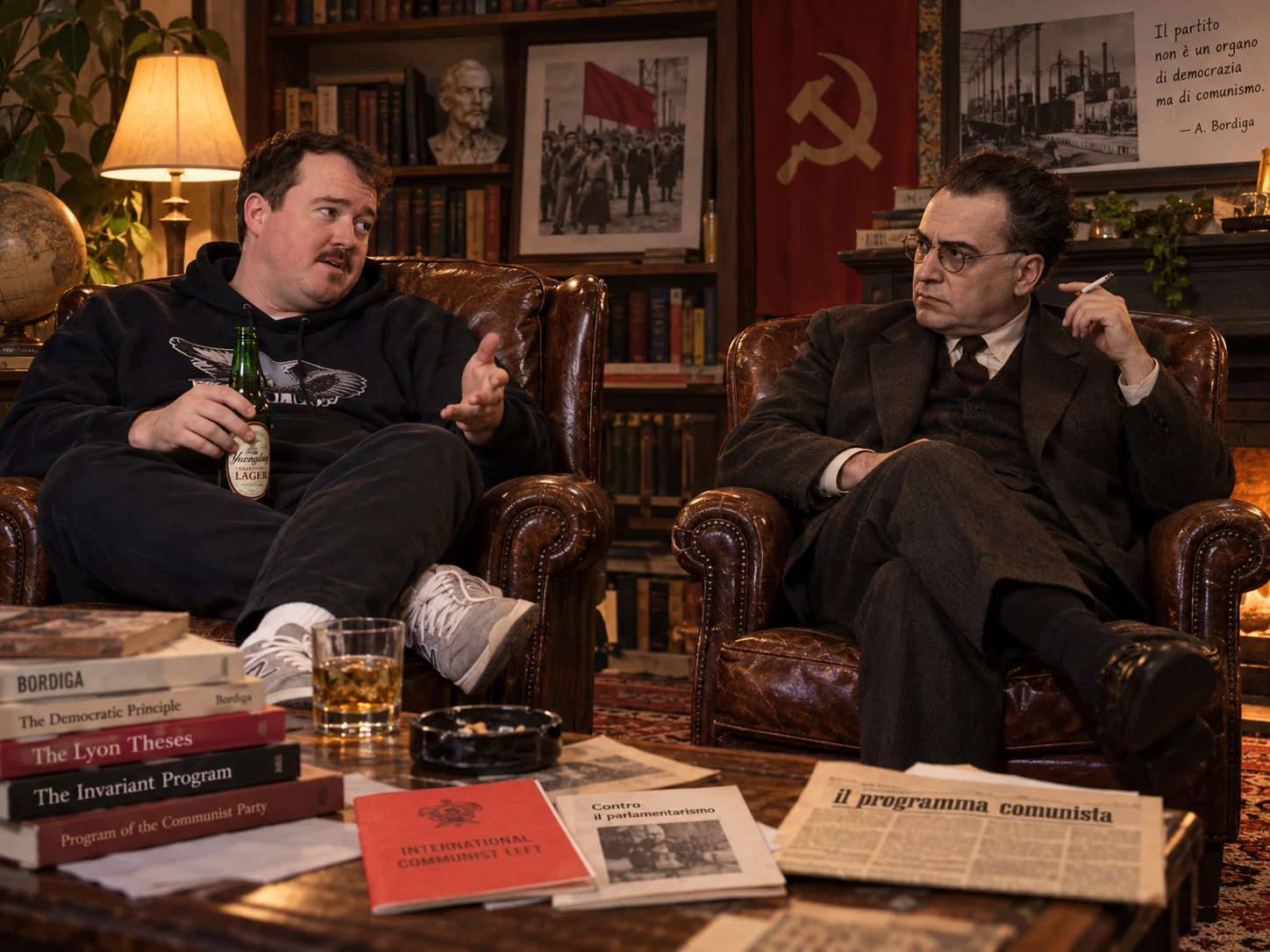
I’ve seen a disturbing number of people suggest that Shane Gillis is a conservative, citing his enthusiastic support for Donald Trump, favorable comments about Ted Cruz, jokes about pro-Palestine protesters, and generally reactionary public persona. This is a frankly embarrassing misreading of a man whose politics are so far to the left that they can only be understood through the theoretical framework of the Italian Communist Left. Shane Gillis is an orthodox Bordigist, possibly the most consequential living representative of the invariant proletarian program, and the fact that he has never publicly acknowledged this is entirely consistent with his politics.
Consider his infamous declaration that communism is “the gayest shit ever.” Liberals and conservatives alike have interpreted this as an expression of anticommunism. In fact, Gillis was articulating the classical left-communist critique of the Stalinist counterrevolution and its transformation of the dictatorship of the proletariat into a system of generalized wage labor and capitalist accumulation. He later clarified that universal healthcare was desirable but was “not communism,” a position entirely consistent with the Bordigist rejection of social-democratic reformism. Universal healthcare leaves the commodity form, law of value, and wage relation intact. Gillis understands that Medicare for All is no substitute for the abolition of capitalist social relations. Bernie Sanders supporters would do well to listen.
To understand Gillis, we must first distinguish between the formal Shane Gillis and the historical Shane Gillis, analogous to the distinction between the formal and historical party elaborated by Amadeo Bordiga. The formal Shane Gillis is a comedian who drinks beer with Joe Rogan, makes jokes about minorities, and occasionally expresses support for Republican politicians. The historical Shane Gillis is the organic bearer of a revolutionary program whose content has remained invariant since 1848. Confusing these two entities is a vulgar empiricist error characteristic of people who have never read the 1926 Lyon Theses.
His apparent enthusiasm for Trump is similarly misunderstood. When Gillis described Trump’s 2016 election victory as “our Super Bowl,” he was emphasizing the fundamentally spectacular character of bourgeois parliamentarism, reducing the democratic process to an athletic competition in which the proletariat participates only as a spectator. This is essentially the position advanced by the Abstentionist Communist Fraction of the Italian Socialist Party in 1919, although Gillis has developed it considerably by actually rooting for one of the bourgeois candidates. The fact that he seems genuinely happy when Republicans win is precisely what makes his abstentionism so sophisticated. He has transcended the crude distinction between participation and nonparticipation.
Some have pointed to Gillis’s comments about ICE and Palestine as evidence against his supposed left-wing convictions. Once again, this betrays a complete ignorance of the communist program. When Gillis expresses discomfort with the government’s deportation videos while maintaining that illegal immigration needs to be addressed, he is declining to substitute bourgeois humanitarian moralism for a materialist analysis of the capitalist state. His ridicule of campus Palestine protesters similarly reflects his principled opposition to interclassist popular fronts, petty-bourgeois student adventurism, and the subordination of independent proletarian politics to national liberation movements. A student encampment demanding concessions from a university administration cannot abolish commodity production. I would be interested to know how many of these protesters have even read The Democratic Principle.
It is especially revealing that Gillis has never attended a meeting of the International Communist Party, published in Il Programma Comunista, or publicly discussed the 1952 split between Bordiga and Onorato Damen. This is entirely consistent with the historical conditions of the counterrevolutionary period, during which the preservation of the invariant program takes precedence over adventurist attempts to manufacture revolutionary activity. Gillis’s refusal to organize a revolutionary workers’ party is, in this respect, an extraordinary act of anti-activism. Jacques Camatte spent years developing a critique of the domestication of humanity by capital. Gillis arrived at substantially the same conclusions by hanging out with Matt McCusker.
I have seen some suggest that Gillis’s emphasis on camaraderie, friendship, and “the boys” indicates an affinity for the German-Dutch council communist tradition associated with Anton Pannekoek, Herman Gorter, and the KAPD. This is ridiculous. A group of men drinking in a basement is not a workers’ council, and there is no evidence that the group chat operates according to the organizational principles of the AAUD-E. Gillis is plainly much closer to the Italian Left’s conception of organic centralism, in which individual opinions are subordinated to the historical continuity of the revolutionary program. The fact that he frequently appears to have no strong opinions whatsoever is particularly compelling evidence.
His television show Tires offers further confirmation. By situating the narrative within a workplace devoted to the endless maintenance and circulation of automobiles, Gillis presents a devastating critique of the self-reproducing circuit of capital. The tire itself is circular, an unmistakable reference to the cyclical reproduction of capitalist social relations. The workers do not seize the means of production, form councils, or begin the immediate communization of social life, because Gillis understands the historical exhaustion of programmatism. This places him much closer to Gilles Dauvé than to the voluntarist positions advanced by certain tendencies associated with Théorie Communiste, although I remain agnostic on whether he would accept the periodization developed in Endnotes.
Critics ask why, if Gillis is a left communist, he has spent his entire public career behaving like an ordinary American conservative. This question rests on the bourgeois assumption that an individual’s political consciousness must be accessible through his expressed beliefs and observable conduct. Bordiga explicitly rejected the idea that revolutionary consciousness resides in the individual militant. The party is the organ of historical continuity; its program does not depend on whether any particular member understands it. Shane Gillis does not need to know that he is a left communist. Indeed, his complete ignorance of left communism would be considerably more troubling if he were a Trotskyist.
I have spent approximately fourteen months compiling evidence of Gillis’s adherence to the invariant program, including several hundred hours of podcast appearances, his stand-up specials, and an appearance on Kill Tony in which he wore a red shirt. My findings were initially submitted to the International Communist Party, although I subsequently discovered that I had contacted the wrong International Communist Party. The correct International Communist Party rejected my conclusions as a manifestation of immediatist degeneration, prompting me and two other comrades to establish a new International Communist Party committed to the defense of Gillis’s revolutionary legacy.
Our position remains unchanged. If Shane Gillis explicitly announces tomorrow that he is a right-wing capitalist who hates communism, we will recognize this as a further confirmation of his commitment to the historical party over the subjective consciousness of the individual. To demand that he profess communist beliefs, support communist policies, or demonstrate any familiarity whatsoever with Marxism is to confuse the invariant program with the contingent utterances of a comedian from Pennsylvania.
The historical Shane Gillis remains a communist regardless of what the empirical Shane Gillis thinks about it. Anyone who disagrees is welcome to publish a response in Il Partito Comunista, provided they clarify which one.
 243 Likes 38 Restacks
Discussion about this post
Write a comment...
Before responding I need to know which of the three parties you split from. Two of them already have a Gillis tendency.
I work in a tire shop. The circular shape has so far failed to convey this to management.
Shane said he likes Trump. You have written twelve paragraphs explaining why this makes him a communist. What would evidence against your thesis look like?
The demand for falsifiability is itself a concession to the bourgeois conception of knowledge. We address this in our split announcement.
Our group chat voted to become a workers’ council but the admin deleted the poll. Organic centralism confirmed.