

Smashing Bank Windows Is Violence Against Queer Graphic Designers
Creative labor, consent, and the limits of solidarity.
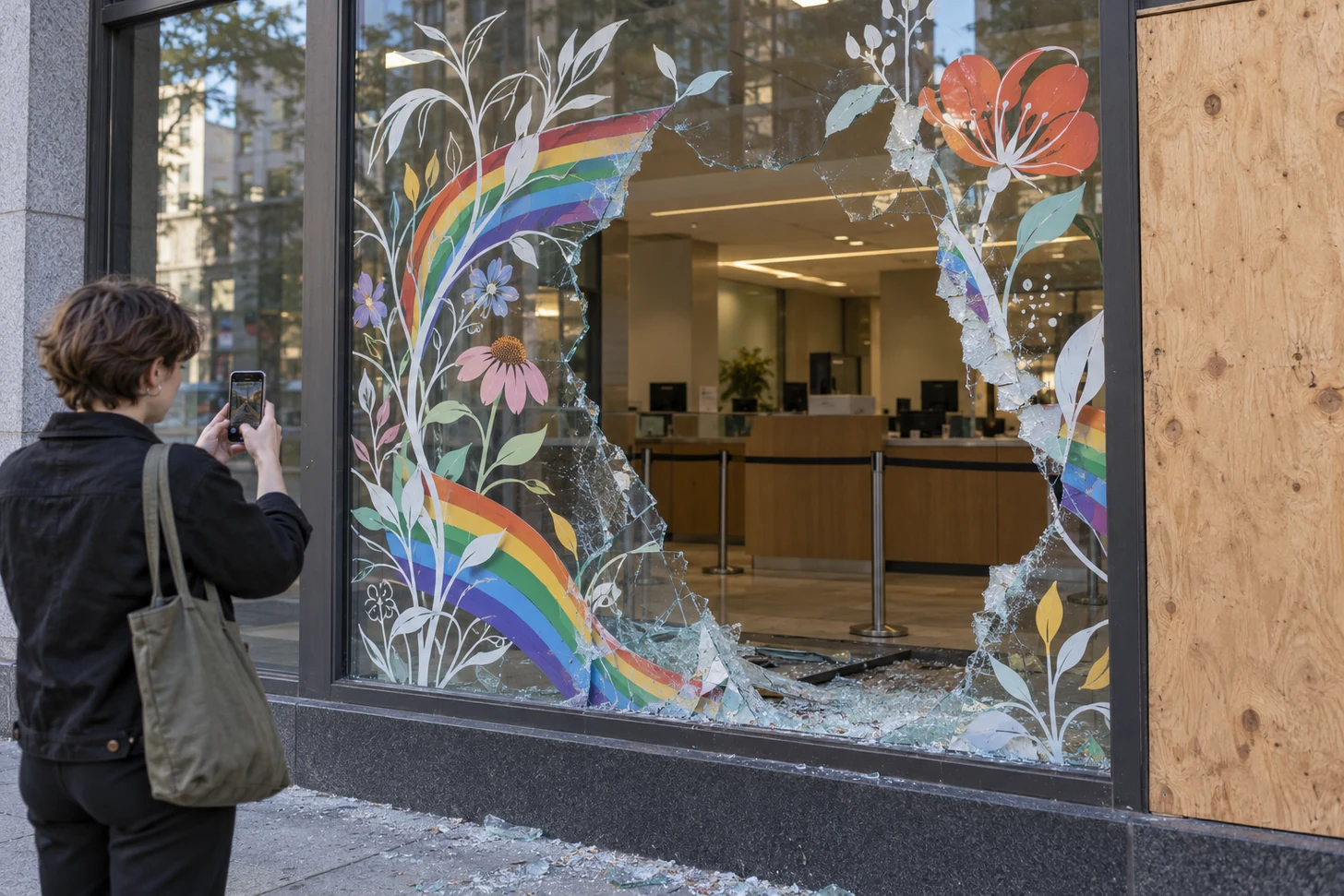
The window you smashed at TD Bank contained forty-three hours of my labor as a queer graphic designer. Before it became a surface onto which you projected your feelings about capital, it was a paid commission by a living artist, with a hand-drawn floral border and lettering developed from my grandmother’s handwriting. You may have understood yourself to be attacking a financial institution. The person who stood across the street the next morning, trying to photograph her portfolio piece through a sheet of plywood, understood the encounter differently.
I designed the branch’s Pride installation after a period in which three prospective clients had asked whether they could simply generate something similar. TD paid an actual fee, accepted my pronouns without discussion, and gave me room to explore belonging through color. At a moment when creative workers are being told that our lives and training can be replaced by AI SLOP, a bank chose to support REAL ARTISTS. That fact belongs in any serious account of what happened to its windows.
The people defending the damage keep sending me information about the bank’s investments, as though a spreadsheet can answer an experience of harm. I did not approve those investments, and the people who commissioned my work are in an entirely different department. My contact, Danielle, spent two calls helping me negotiate an additional revision fee. Flattening her into “finance capital” erases a woman who used the institutional power available to her to move money toward a marginalized person.
There is a familiar hierarchy operating here, in which certain forms of labor become politically legible while others remain decorative. You can imagine a worker building something with a hammer, but you struggle to imagine a worker adjusting the spacing between letters until a message of inclusion feels welcoming rather than compulsory. I spent an entire Sunday on that spacing. When you insist that the window was merely bank property, you reproduce the employer’s legal understanding of my work at the very moment you claim to be challenging it.
One organizer asked whether the bank would pay to replace the installation. I found the question revealing, because compensation does not retroactively make violence acceptable. Yes, I have been offered a second fee, and yes, the photographs of the damage have brought more attention to my practice than the original campaign received. Neither development gives strangers the right to decide that a queer person’s visibility is an acceptable casualty of their political education.
I am also troubled by the assumption that people entering a bank should have to encounter your anger without consenting to it. Queer and trans people have bank accounts; disabled people use ATMs; immigrants send money to their families. My mural was intended to help those people feel that they belonged in the financial system. Covering it with a demand to abolish that system tells everyone who has fought for inclusion that their hard-won place inside it remains contingent on the approval of a small group of people dressed for a confrontation.
We need a model of protest that accounts for the people an institution has chosen to uplift. Before targeting a branch, organizers should consult the artists, community partners, and brand collaborators whose work might be affected, with honoraria reflecting the labor involved in that consultation. If your movement cannot afford to compensate us, that is a capacity issue for your movement to resolve. It does not entitle you to proceed as though our consent has no value.
TD has asked me to propose a new installation about resilience, and I have invited several of the organizers to participate in a listening session. The session will center my experience, so we will not be relitigating the bank’s lending practices or using the space to debate whether the institution should exist. There will be an opportunity to apologize, followed by a facilitated discussion of how future demonstrations can remain visible from the sidewalk without interfering with the windows. I hope they come prepared to do the work.
 683 Likes 97 Restacks
Discussion about this post
Write a comment...
Our studio lost two clients after asking for deposits, so I understand what it means when an institution agrees to pay properly. I would want that relationship protected too. Have you asked Danielle whether the branch could fund a workshop for organizers on commissioning and licensing?
The bank sponsored our neighborhood arts festival the same year it foreclosed on the building where we rehearsed. We were also told those were separate departments. The festival committee still had to find somewhere else for everyone to practice.
That sounds like a conversation worth having with the lending team. The arts team cannot do that work for them, and withdrawing support from artists would only make the situation worse.
I installed the original panels. The replacement is booked for Sunday before opening because the branch does not want the work visible during business hours. Two of us will be there from five. I have asked whether your consultation budget includes our time.
Did the contract transfer ownership of the installation, or did the bank license it? I ask because artists are often expected to identify personally with work while surrendering every right to control how the client uses it.
The agreement was a full buyout. I negotiated that knowingly, and I am comfortable with it. A legal transfer does not extinguish the obligation to respect the person who made the work.
Thank you for naming the work our team put into this partnership. We would love to use a passage from this essay in the resilience campaign. Please send a quote for the listening session and a separate usage fee; communications has approved both budget lines.