
We Need More Queer Third Spaces. That's Why I'm Buying Them.
What Stonewall can teach us about community, ownership, and a good relationship with the police.
Queer third spaces are disappearing. The bars are closing. The bookstores are closing. The piers, where queer kids went when they had nowhere else to go, are a park now, with kayak rentals.
Everyone agrees we need more queer spaces. What nobody wants to talk about is who should own them. I’ve spent a lot of time on that question, first in private equity and now as the founder of Commons, and I’ve landed somewhere simple: someone should, and it should be me.
The tragedy of the commons
Economists have a name for what happens when a space belongs to everyone: the tragedy of the commons. Nobody takes care of it, anybody can come in, and eventually it’s ruined. That’s what happened to the piers, the parks, and the bathhouses. Public space was never safe for us, because public space lets in the public.
In eighteenth-century England, common land that anyone could use was fenced off and handed to owners who could actually take care of it. Historians call that enclosure. I call it a safe space.
Stonewall was a private club
People talk about Stonewall like it was a commons. It wasn’t. The Stonewall Inn was owned by the Genovese crime family, who saw an underserved community and met it where it was.
It was technically a private club. You knocked, a doorman looked you over through a peephole, and you signed the book, usually as someone else. The drinks were watered down and the prices were high. The Sixth Precinct was paid off, so raids usually came with a heads-up, and the owners had time to hide the liquor. High-net-worth members got a more personal kind of service, which historians call blackmail and I call retention.
The doorman managed admissions, the owners managed the police, and someone collected a membership book. I recognized three lines of our current operating model before the tour guide had even finished his story.
People remember the riot. I remember the business model. It worked for years: private ownership, a curated door, premium pricing, and a strong relationship with law enforcement. The riot only happened because one raid wasn’t on the calendar. That’s not a failure of the model. It’s a failure of communication.
Commons
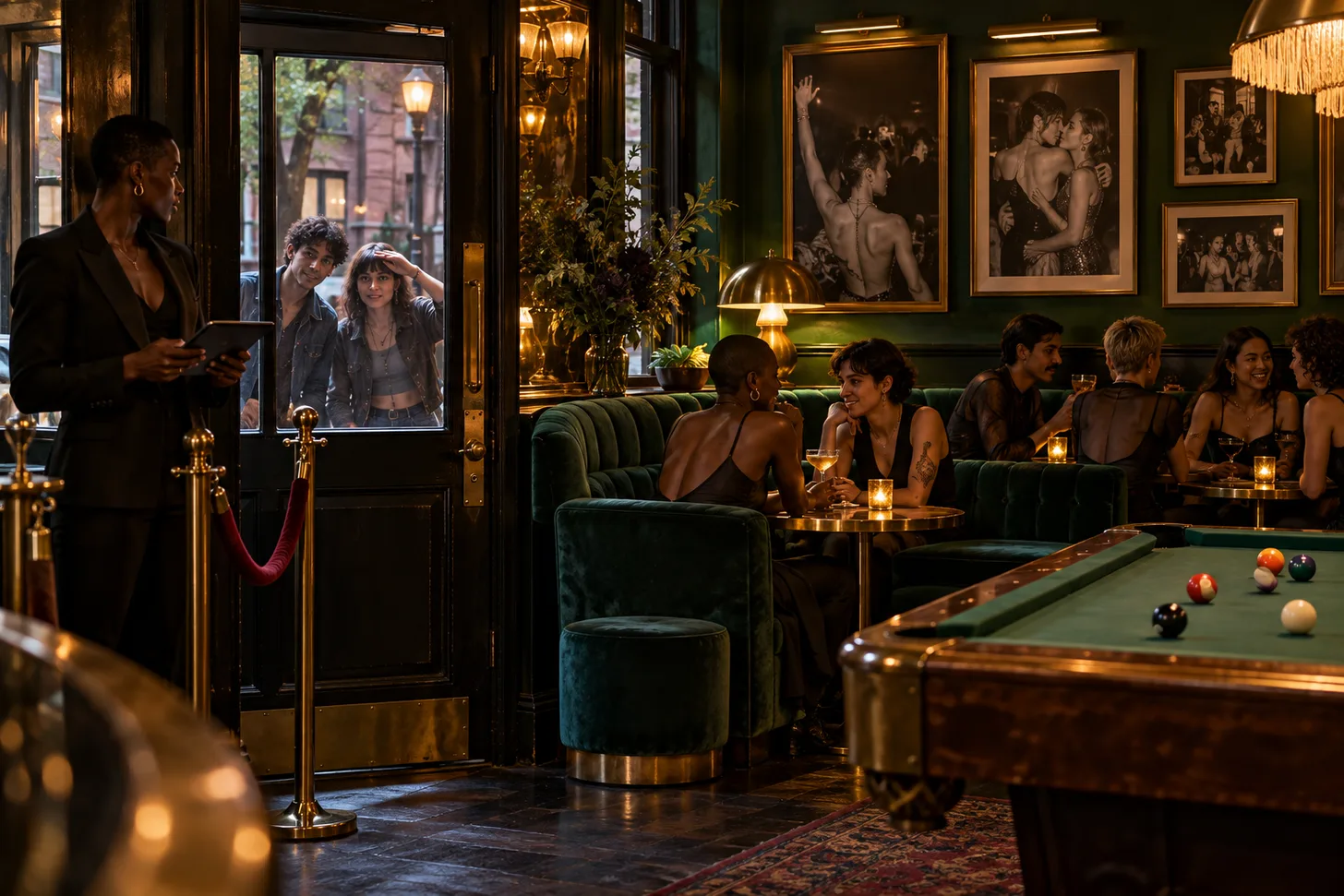
That’s the model for Commons, the members’ club for queer community I founded in 2024. We have three locations in New York, one in Miami, and a new one in the West Village, in a lesbian bar that had been open for forty years until we bought the building in January. We kept the pool table and named the back room after one of the old bartenders. We called the whole thing Commons, because that’s what it used to be.
Membership is $4,200 a year, on a sliding scale that starts at $3,800. Every application is reviewed by our Community Council, which is me and two of our investors. We don’t let everyone in. That’s what makes it a community. Allies are welcome at a 20% premium, which they’re always happy to pay.
And unlike Stonewall, we’re completely transparent about our relationship with the police. The NYPD isn’t allowed to march at Pride in uniform anymore, so every June we host them on our roof, in uniform. That’s inclusion.
What about the kids?
Some people ask where queer kids are supposed to go now, the ones who used to go to the piers. It’s a fair question. But Commons is a members’ club, not a shelter, and our insurance is very clear about that. The piers are still there. They’re much nicer now.
What’s next
This month we closed a $40 million round to buy independent gay bars across the country and bring them onto the Commons platform. A lot of them are family-owned, underinsured, and one bad year from closing. We see them. We’re making offers.
Queer people built these bars, staffed them, and kept showing up when the landlords raised the rent. Our acquisition team has made a map of that work and attached an offer price to each address. When the next owner is ready to sell, Commons can take responsibility for the space, set the membership terms, and retain the name that made people love it in the first place.
Paid subscribers skip the Commons waitlist. Founding members get a brick from the old bar.

 1.4K Likes 131 Restacks
Discussion about this post
Write a comment...
I was at the piers in ‘79. We built that with nothing.
Imagine what you could have built with capital.
I poured at that bar for 22 years. You kept the pool table and let all of us go.
And we named the back room after you! It’s available for private events.
See you on the roof in June 🌈
Just applied for the ally tier. Can I expense the premium?